Smart Soil Organism Detector
Expanding the Frontiers of Organismal Biology
Executive Summary
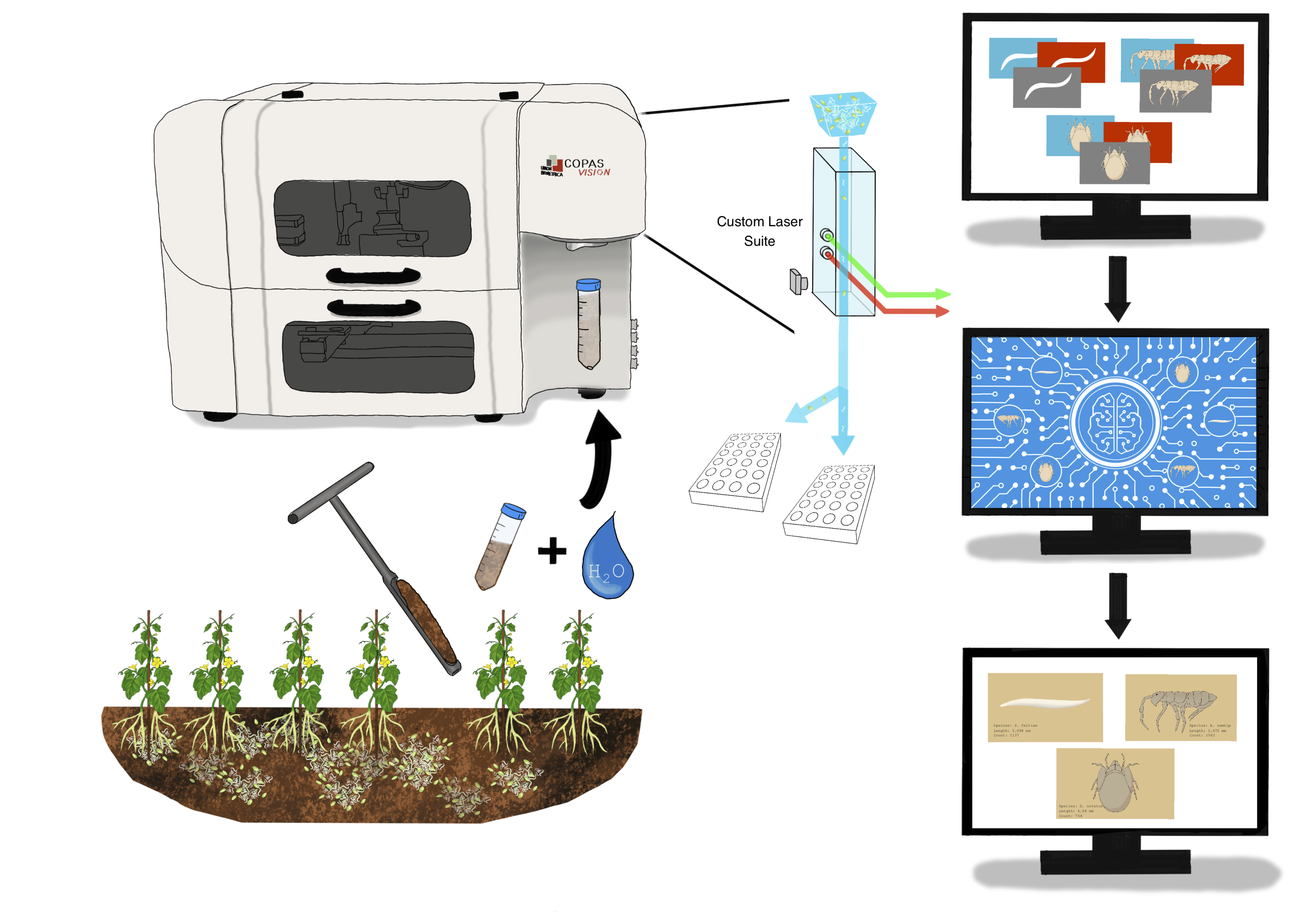
The Smart Soil Organism Detector (Smart SOD) enables high-throughput, low-cost counting, sorting, identification, measurement, and isolation of live and dead organisms ranging from a few microns to 2mm in diameter directly from their environment in a non-destructive manner. Compared to traditional pipelines this technology can engender performance improvements exceeding two orders of magnitude. Originally designed to isolate and identify soil organisms directly from the soil, the Smart SOD integrates a custom engineered large-bore flow cytometer, a custom laser and high speed camera sensing suite, with a machine learning pipeline to process living organisms at up to 2,000 organisms per minute. Current applications for this technology include rapidly assessing the pathogen levels of agricultural soils, early warning and detection of wind-bourne and soil-bourne pathogens, assessments of soil biodiversity, high-throughput discovery of novel organisms, assessment of marine organisms, and evaluations of microplastics in soils and the oceans. Our team, consisting of Dr. Filgueiras with a background in agricultural engineering and soil biology and Dr. Willett with a background in data engineering and machine learning, is interested in rapidly scaling this technology to meet demand.
Soil: A Final Frontier
Soil forms the basis for terrestrial agriculture. Beneficial organisms in the soil support healthy plants and productive agricultural systems while pathogens cause hard to diagnose diseases that can lead to devastating losses. Despite the importance of healthy and productive soils for life on earth, it is perhaps the least quantified and understood ecosystem on the planet. Studying and quantifying soil organisms has historically been challenging. Isolating organisms from the soil, counting them, identifying them, and culturing them can take months to years. In addition, specific taxonomic expertise is needed for this work. Years are spent developing expertise in pathogenic nematodes for example, but such expertise does not translate for understanding harmful soil mites.
Despite the challenges, there is great demand for information about soil organisms. Agricultural producers spend 10-100s of dollars for diagnosing specific nematode species while sometimes waiting weeks for results. Much of this work is done by PhD level technicians manually working with soil samples and examining individual specimens under microscopes. Modern DNA methods are making inroads but remain costly, require additional expertise and prior taxonomic knowledge, and results often can not be clearly linked to localized populations.
Marine Systems
While Soil may be a final frontier, marine systems are not far behind. A plethora of unknown and little studied small organisms dominate marine systems including both beneficial and pathogenic organisms affecting aquaculture systems. While diagnoses in these systems seem to be a bit more advanced, there are still challenges in achieving high-throughput estimates of organism populations.
Smart SOD | The Smart Soil Organism Detector
The Smart Soil Organism Detector removes a number of these challenges to facilitate high-throughput isolation, counting, sorting, and identification of organisms in a non-destructive manner that does not require taxonomic expertise. It is an instrument that accepts as input any liquid based mixture containing particulate matter and organisms. Using a combination of flow cytometry, sensors, and machine learning, this instrument simultaneously separates, counts, sorts, and identifies living and dead organisms in a matter of minutes what would have taken days to years by PhD level experts.
Capabilities
- Separates organisms from substrate (soil, sand, water) automatically.
- Separates live organisms, dead organisms, and organism parts automatically.
- Can place desired number of organisms individually or jointly in microplate wells non-destructively for further processing in culturing or next-generation-sequencing pipelines.
- Can identify with high taxonomic detail individual organisms across large taxonomic groups without expert intervention.
- Automatically counts number of individuals of each organism type.
- Can process up to 2,000 organisms per minute on a single instrument.